• Skip to primary navigation
  • Skip to main content
  • Skip to primary sidebar
  • Texas A&M Forest Service
  • Texas A&M Veterinary Medical Diagnostics Laboratory
  • Texas A&M AgriLife Extension Service
  • Texas A&M AgriLife Research
  • Texas A&M College of Agrculture and Life Sciences
Hunt County Master Gardeners
Hunt County Master GardenersTexas A&M AgriLife Extension Service
  • Menu
  • Home
  • About
    • A History of the Master Gardeners in Texas
    • Outdoor Learning Center
    • Master Gardeners Emeritus
      • Lamont Cunningham – Hunt County
      • Madeline Sullivan – Hunt County
  • The Heritage Garden
    • Bed A – Butterfly Bed
    • Bed B – Earth-Kind Bed
    • Bed C – Sustainable Plant Bed
    • Bed D – Herb Bed
    • Bed E – Vegetable Bed
    • Bed F – Animal Name Bed
    • Beds H & I – North & Northeast Perimeter Beds
    • Bed J – Shadeless Bed
    • Bed K – OLC
    • Bed L – Wildflower Bed
    • Bed M – Rose Bed
    • Heritage Garden Plant Database
  • Events
  • Links
    • Hunt County Extension Office
    • Texas AgriLife Extension Bookstore
    • Aggie Horticulture
    • Aggie Turf
    • Texas Master Gardener
    • Texas Master Gardener Association
    • Texas Master Gardener License Plates
  • Articles
  • Resources
    • Plants for East Texas
    • Vegetable Resources
    • Fruit & Nut Resources
    • Texas Plant Disease Diagnostic Lab
    • Soil, Water and Forage Testing Lab
    • Texas Superstar Plants
    • Earth-Kind Landscaping
    • Insects in the City
    • USDA Plant Hardiness Map
  • CEUs
    • Log My Hours
    • Texas Master Gardener Association Events
    • Master Gardener Advanced Training
    • Earthkind Online Classes
    • American Horticultural Society Events
    • Texas Botanical Gardens and Arboreta

Turfgrass

June 6, 2018 by jhsanger

Turfgrass by Karla Basallaje, Master Gardener.

Because it serves so many purposes and provides many benefits, it is easy to forget that turfgrass is likely the largest plant in your garden. Not only does it provide your home with curb-appeal, it controls soil erosion and runoff; it limits dust and noise, as well as helping to dissipate heat. As with other plants in your garden, they need care; more specifically, your lawn needs to be mowed, watered and fed.

Ideally, it would make sense to start with a soil test, so that a better understanding of what nutrients your soil needs to support the plants growing in it can be determined. Mowing is a crucial step in maintaining a healthy lawn. Experts recommend mowing no more than a third of the grass blade. Keep your mower blades sharp so that the grass blade is cut and not torn. The height of the grass blade affects how much chlorophyll the grass has available for photosynthesis. The more green tissue is available, the more carbohydrates are produced and stored, especially in the spring and summer, which is growing season for warm season grasses. Conversely, the shorter the blade, the weaker and more stressed your turf becomes as carbohydrate production and storage is reduced, leaving your lawn vulnerable to insect attacks, disease, and weed spread due to the lack of reserves. Don’t bag your clippings; mulch them into the lawn to reduce water use, to help choke out weeds and help put nitrogen back into the soil.

The first step to evaluating your watering needs is to make sure your irrigation system is in good working order – look for broken or leaking sprinkler heads. Do not water sidewalks or driveways. Don’t over-water your lawn. Never water your turf to the point of run-off. It is preferable to irrigate more deeply to encourage root growth, which will withstand dry weather better. The general recommendation is to water about one inch of water per week. There are, however, mitigating factors to consider including soil type and weather. The best time to water is in the morning as opposed to the evening to avoid moisture clinging to your lawn throughout the night making it susceptible to disease. Visit texaset.tamu.edu for assistance in calculating sprinkler run times.

The time to start fertilizing your lawn is sometime in the spring as there is usually enough reserved nitrogen to see the grass through the first two or three mowings. Examine your lawn and if growth appears vigorous, you can wait to fertilize until May. In the absence of a soil test, apply fertilizer with a 3-1-2 nitrogen, phosphorus, potassium (N-P-K) ratio (example: 15-5-10) or a 2-1-1 ratio (example: 15-5-10). Continue to observe your lawn and apply fertilizer every 6-8 weeks or so during the growing season depending on the turf and type of fertilizer.

With proper and diligent care, many turf problems may be averted. Most insect problems take place in full sun, while most disease problems take place in the shade. Lawn problems usually appear as brown or yellowing spots and can range from drought stress to brown patch to chinch bugs.

For help in determining lawn problems see the helpful earth-wise guide and flow chart at aggie-horticulture.tamu.edu

Filed Under: Turf

Fire Ants

May 23, 2018 by jhsanger

Fire Ants by Byron Chitwood, Master Gardener.

It’s that time of the year when you begin to notice that you have fire ants in your yard or pasture. Actually, they have been there all through the winter. They just set up housekeeping deeper underground to avoid the cold. Now that the temperature has warmed up, they have moved closer to the surface of the ground, especially after a rain. As the water level rises after a rain, fire ants will build a fluffy mound above the surface of the water level to protect the queen and babies. If you happen to disturb one of these mounds, they will come out in mass and attack and sting everything that moves. Where they sting, will get red, hurt, itch and eventually develop into a pus pocket. People who are highly sensitive to fire ants might require medical treatment. Take precautions when working in the yard or garden. Precautions include wearing knee high rubber boots with pants legs tucked in. Wear gloves and long sleeves. Work in the yard or garden during daylight hours so that you can see and avoid mounds.

Fire ants can be controlled using the “Texas Two Step” approach. Note, I said controlled, not eliminated. This method consists of the following procedures:

Broadcast Bait: Broadcast bait throughout your lawn and vacant lots with a hand held or push type spreader. Set the spreader on its lowest setting. There are many brands of bait available at your favorite garden and yard supply store. Follow the directions on the package. Most advise broadcasting 1 to 1.5 pounds per acre. This is not very much but that is all that is required for control. The fire ants will forage for food during the night and carry it back to the den where it is fed to the other ants and the queen. When the queen dies, that will be the end of the colony since she is the only ant in the family that lays eggs. All of the ants will eventually die, either from eating the bait or at the end of their life cycle.  Apply bait only when the weather is warm enough for the ants to forage. To determine if they are foraging, apply a small amount of bait on top of the mound and if it is gone within 30 minutes or overnight, they are actively foraging. Do not disturb the mound after application. This can cause the ants to move their colony.

Mound Treatment: If you have a problem mound, one that you can’t avoid, treat it by applying either a granular, liquid or dust type insecticide directly to the mound. Follow the directions on the insecticide container. Usually, the directions recommend sprinkling a small amount on the mound and watering it in with several gallons of water. Use a hand held watering can if you have one or a gentle spray head on the end of your garden hose. Water very slowly so that the insecticide has time to sink in and reach the deepest part of the ant colony.

It would good practice for your neighbors to treat for fire ants at the same time. It doesn’t take long to spread the bait and usually, it is more economical to buy large quantities of ant bait which can be shared with your neighbors. Most ant baits contain oil which will eventually get rancid after the package is unsealed. Sharing the cost and treating a larger area will forestall the next invasion of fire ants on your property. For further information on fire ants, go to the website http://fireants.tamu.edu.

Filed Under: Entomology, Turf Tagged With: Fire Ants,

Garden Tour – Garden #4: Hunt County Heritage Garden

May 23, 2018 by jhsanger

The Master Gardeners of Hunt County invite you to come to our Garden Tour on Saturday, June 2, 2018. Tickets are $5 and are available at the Texas A&M AgriLife Extension office at 2217 Washington Street, Greenville; the Garden Center, 4701 Stonewall Street in Greenville, and Steve’s Nursery, 4386 Hwy. 34, in Cash. The Garden Center and Steve’s will be selling tickets until the day of the Garden Tour. You may also buy tickets electronically through Eventbrite. On the day of the tour, tickets can also be purchased at the entrance to each site.

The Heritage Garden at 2217 Washington Street in Greenville is located next to the Texas A&M AgriLife Extension Office. Hunt County Master Gardeners volunteer many hours to maintain the garden and constantly create new designs. It is free and open to the public and can be depended on for being beautiful year-round.

The garden features an herb bed, an animal bed (all plants are named after animals), a butterfly garden, perennial beds, a wildflower bed, and a vegetable garden. Behind the main garden is a rose bed that was created as a test garden. These roses have faithfully survived our Texas heat and droughts. You’ll also appreciate the garden bed that features shade-loving plants. These are helpful to know about for gardeners who simply don’t have the six to eight hours of sunlight to grow most vegetables, herbs, and flowers.  There’s a huge, old tree with a bench around it for those who’d like to sit and enjoy a little shade while relaxing and enjoying the subtle fragrances from nearby flowers.

The Outdoor Learning Center (OLC) was partially constructed with funds raised by the 2014 Greenville Follies. It is available for gatherings to all residents of Hunt County. Master Gardeners enjoy giving horticultural talks in this protected area. Surrounding the OLC are Chinese fringe flower shrubs, Indian Hawthorne shrubs, trees, miniature butterfly bushes, purple trailing lantana, daylilies, and assorted bulbs that bloom from spring until the first frost appears, usually in November.  Behind the Outdoor Learning Center is a rainwater collection system. The gardens are all watered by a drip irrigation system to conserve water.

We hope you’ll stop by to visit this beautiful spot as you enjoy all the lovely venues on this year’s 2018 Hunt County Master Gardeners’ Garden Tour!

Filed Under: Events

Water Efficient Gardening

May 9, 2018 by jhsanger

Water Efficient Gardening by Wayne Bowman, Master Gardener.

There’s one constant fact of gardening: If it grows, it needs water. This includes the garden you call your lawn, your flower beds, and that patch where you struggle to grow a few edible vegetables.

In case you haven’t noticed, Northeast Texas is booming, and there’s no end in sight. A critical issue for now and in the future is maintaining an adequate supply of quality water. The pressure on an already limited supply is increasing with the population. Other issues with which we Texans must contend are dry summers and occasional drought. Sometimes we have sufficient water; sometimes we don’t– so we best take care of what we have.

We’re all in this together, so what can we do to help?  Plan for the demand. You don’t need to turn your lawn into a rock garden filled with cactus, or a concrete slab. Choosing the right turfgrass for our climate and soil will make better use of landscape water. Bermuda, St. Augustine, and Zoysia are all suitable for our climate, requiring low to moderate amounts of water. If you have an area where there is little traffic, Buffalo grass is excellent and requires the least care and hydration.

Nearly 25% of urban water usage is attributed to lawn irrigation. I’m sure you’ve seen someone watering the street with a poorly planned system or irrigating during a driving rain. Many urban areas now limit the number of days lawn watering is allowed. Just because it’s “your day” to water, doesn’t mean your lawn is thirsty. Using a “cycle and soak” method prevents most runoff by watering for a shorter period of time, then allowing a period for the water to soak into the soil, followed by another, or several, cycles and soaks. If you haven’t already, consider adding to your system a soil moisture monitor that will only allow the system to activate if the soil needs a drink, and a rainfall monitor to stop watering when the heavens are doing the irrigation. Your watering cycles should be set for the early morning (4:00-6:00 am), to take advantage of better water pressure, lower wind, and less evaporation caused by the sun. Aerifying (plugging) your turf will help moisture get to the root systems, making more efficient use of both fertilizer and water. Don’t forget to monitor the system for leaks, etc. Unchecked leaks waste huge amounts of water.

In the garden and flower beds, drip irrigation allows a more precision watering system. Properly designed and installed, it delivers a slow and deep watering to the root zones of your plantings, reducing water loss through evaporation.

Properly conditioning your soil, for both turf and garden, will contribute to the best use of water. A soil test should be considered a must before you plant. Organic amendments will help the clay soils of Northeast Texas better absorb water and nutrients. The benefits of using mulch cannot be stressed enough. A 2-6 inch layer of mulch will protect the soil in your garden from drying out, preventing the baking effects of sun and wind. Layering mulch over a drip irrigation system will make your watering more efficient.  Instead of bagging lawn clippings, consider leaving them on the lawn to return nutrients to the soil. A mulching lawnmower and more frequent mowing benefits your lawn and prevents beneficial clippings from wasting away in a landfill.

Choose your plantings wisely, taking into consideration the amount of time you wish to spend tending them and how well they are adapted to our climate.  Check with your local certified nursery professional about Texas Superstar plants that have been tested under “Texas conditions.” Visit TexasSuperstar.com for more details.  Proper planning, maintaining your irrigation system, mulching, and choosing the right plantings add up to a better lawn and garden, while saving a natural resource and your water bill.

Filed Under: Gardening 101, Water Conservation Tagged With: Watering

Hanging Baskets

April 25, 2018 by jhsanger

Hanging Baskets by June Morgan, Master Gardener.

Hanging baskets can add much to the outdoor porch and deck summer decor, but it can be a challenge to keep them looking their best. Proper siting, basket design and proper watering are key elements of good management.

The best setting is a protected area which allows sunlight from above or the sides such as a deck canopy out of the strong winds which will tear the plants apart.  In contrast to the ordinary solid plastic container, the larger mesh basket is the most visually effective while also holding the most soil and plants. Also, coco fiber or sphagnum moss looks more natural when viewed from below. Coco fiber is a natural insulator against the heat and helps to keep the soil evenly supported inside the fiber liner. Some ambitious gardeners have their baskets made to order from a metal shop using special ornamental effects.

To set up a basket from scratch, start with a fiber layer, then a plastic sheet with holes in the bottom. Add a soil-free potting mix that includes water holding crystals, then add a slow-release fertilizer. If using sphagnum moss soak it overnight before using. Now, one can get creative with plants. Try an upward growing plant such as coleus and surround it with a vine such as one of the many ivies or trailing pelargoniums. Further plant additions can be made by wrapping roots in paper for protection while slipping them through side slits into the potting mixture.

Watering baskets is more challenging than for ground plants. Quite often, using a hose will simply result in water immediately running out of the bottom. One solution is to soak the whole basket in a container such as a wash tub of water for several hours or even overnight. Another is to fill a large pan of ice and dump it into the basket, ensuring a slow melt of water. To care for your baskets during the season, deadhead the flowers, fertilize once a week and keep watered.

Beyond the run-of-the-mill baskets available in big box stores, check out the uncommon local nurseries, seed catalogs, the internet (google hanging baskets), and wherever herbs and tomatoes are available as possible basket material. So, don’t settle for just the common offerings. Put together your own combinations to bedazzle the eye!

Filed Under: Flowers, Gardening 101, Ornamentals

Summer Vegetable Gardening

April 18, 2018 by jhsanger

Summer Vegetable Gardening by Karla Basallaje, Master Gardener.

Hot Texas summers do not necessarily signal the end of our time in the garden.  There are a variety of vegetables that can be sown from April through early May for harvest in the summer.  In addition, some of these vegetables can be planted on a staggered schedule to reap a continuous harvest throughout the summer.   The goal is to keep your garden growing and producing fresh harvests.  Planting different varieties of the same vegetable can also help make the most of the growing season because they mature at different intervals thereby extending the harvest season.

It is preferable to plant summer vegetables early rather than late so that the crop can reach maturity before the heat becomes too intense.  Most warm weather vegetables germinate successfully at soil temperatures of 70 to 95 degrees Fahrenheit, they require 6-8 hours of full sun, well-drained soil as well as adequate amounts of water.  Remember to keep the soil evenly moist and to mulch to conserve moisture.

Summer garden staples include: beans – also referred to as green beans, snap beans, string beans, they are a favorite and versatile warm weather crop.  Sow every 7-10 days to produce a continual bean crop.  Harvest beans before they grow too big as they become stringy and tough.  Beans are also a favorite as they fix nitrogen levels in the soil.  Early August would be the last practical sowing date for beans.

Peppers and hot peppers are another favorite summer vegetable, most commonly transplanted, but also sown from seed.   Summer squash, such as zucchini are planted in March and April for harvesting in May through June.  Cucumbers, a native vegetable of India can be sown from March through May 1st both the slicing variety and the pickling kind.

Okra cannot be left off the list of favorite summer vegetables.  Okra is a large plant and needs plenty of space to grow and also night temperatures must reach an average of above 50 degrees for the okra to grow properly usually 3 to 4 weeks after the last spring frost.  Okra needs to be harvested in a timely manner; it matures quickly generally 4 days after flowering.  Harvest pods before they become too tough.

Finally, don’t forget to try something new!  Bittermelon is an excellent summer vegetable, a super-food with purported blood-sugar regulating capabilities.  It is actually a member of the squash family and also a native to India.   It is used in curries and stews also very popular in Chinese and other Asian cuisine.  Planted from seed, it is a hardy plant and a prodigious producer. If you have never tasted it, sample it first.  They are widely available at Asian grocery stores. To temper the bitterness, it is sometimes cut and cored, and sprinkled with salt or soaked in water for 30 minutes before cooking.

For more detailed information on the vegetable you would like to plant visit the Aggie Horticulture website at htttp://aggie-horticulture.tamu.edu, and look for the “Easy Gardening Fact Sheets’ for commonly planted vegetables and herbs.

Filed Under: Uncategorized Tagged With: Summer, Vegetables

Raised Bed Gardening

March 28, 2018 by jhsanger

Raised Bed Gardening by Wayne Bowman,  Master Gardener.

Spring; time to look ahead to planting, growing, and eating our own fresh vegetables.  So, you thought you’d try your hand at raised beds, since you don’t have loads of space.  Great!  First, though, you’ll need to build it, and planning is the key.

When planning your raised beds, placement, materials, size, and use must all be considered.

Placement:  Just about any nearly flat surface is good.  For many, however, there’s another consideration; the Home Owner Association.  If you live in a developed community or an urban setting, it might mean your HOA has restrictions on where and what you might build or grow.  City zoning restrictions may apply too.   It’s best to check before you buy the lumber, or you may be paying for more than just the nails.

Materials:  This is subject where you can be quite creative.   A neighbor uses several stock troughs for his.   My wife used hay bales, which lasted a few years.  When the bales rotted they became a great amendment to our black soil.   Bricks, concrete blocks, or anything that will contain soil are all useable.   The bed can also be purchased in kit form, ranging in price from around $50.00 to several hundred.  By far the most common is the do-it-yourself wooden bed, but I’ve seen pre-fab beds in metal too.

Choose something that is rot and insect resistant.   Cedar is a good choice but expensive.  Preservatives in treated lumber have changed and are no longer as toxic to humans as they once were.  Use the type rated for ground contact.  If you still have concerns about the chemicals, as some do, a plastic liner or coating the wood with a sealer will prevent most chemicals from leaching into your soil.   Under no circumstances should you use old railroad ties.   They’re great for retaining walls or lining driveways, but still retain a lot of the preservative creosote, which is both toxic and corrosive.  Never a good combination.

Size:  This depends on how far you can comfortably reach and your available space.  You’ll want to make sure you can reach the center of the bed without stepping into it.  Consider, too, if your kids will be helping you and size the width of the bed so it’s within their reach.  Two 8 ft 2×10’s can frame a 4 ft by 4 ft bed nicely.  If you’re thinking bigger and have the room, go longer, rather than wider. How high the bed is raised should be considered.  For those of us who are a bit more advanced in age, the bed can also be built on legs, eliminating bending and stooping.

Use:  Wow! This is a subject that would take a book to cover.  In fact, there are many that do.  Done carefully, even corn can be grown.  I would shy away from plants such as pumpkins.  My wife did this one year and it overgrew the bed, far into the lawn!  My best advice is to grow what you like to eat or look at.

Happy gardening!

Filed Under: Gardening 101 Tagged With: Raised Beds, Vegetables

The Aggie Method of Leaf Propagation – and This is No Joke

March 23, 2018 by jhsanger

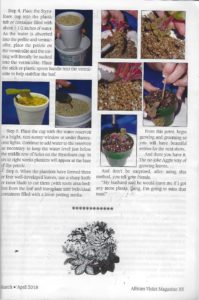
“The Aggie Method of Leaf Propagation – and This is No Joke” by Master Gardener Sylvia Leeds as published in African Violet Magazine March – April 2018.

Filed Under: Flowers Tagged With: African Violets, Propagation

March Vegetable Gardening

March 21, 2018 by jhsanger

March Vegetable Gardening by Byron Chitwood, Master Gardener.

If you planted tomatoes, peppers and potatoes before the 14th of March, chances are that the vegetables suffered some frost damage.  I visited with a large nursery in Frisco yesterday and they said that people got in a hurry to plant these sorts of things because of the mild weather we were having.  I did have some tomato plants planted but they were in large pots and I have been putting in our warm garage overnight.  However, my potatoes were up and suffered some frost damage.  I don’t think it will be fatal for them.  Just remember that the average date of our last killing frost is March 20.  That means we can always have one or more after March 20 so with frost sensitive vegetables, it is better to wait until after April 1 to transplant them to your garden plot.

After March 20, it is ok to plant all kinds of beans and peas, corn, cucumbers, egg plants, mustard greens, squash, tomatoes and watermelon.  After April 1, okra, field peas, and pepper plants can be planted.  Check the local weather station for the possibility of frost and be prepared to cover these plants in case of temperatures predicted in the los thirties.  Some of the vegetables that are planted from seeds might not germinate properly if the soil is too cold when they are planted.  If they have not all germinated and sprouted within two weeks, replant w here needed.  Sometimes, green beans will sprout in cold soil but the infant plants will not have good leaves.  Replant these too since they will not develop into productive plants.

If you have a very large garden plot and plan to plant green beans, rather than plant them all at once, stagger planting dates every five to ten days.  That way, you will have a lengthened harvest period.  You might get tired of eating green beans every day but I’ll bet that your neighbors won’t.

If you plant a lot of your vegetables from seed, they will need ample water to germinate and grow an ample root system.  Keep the soil moist until after the seeds have germinated and developed a good root system.  If it is a dry spring, water the plants at the first sign of wilting.  Rainwater is the best for your garden but if there is not enough frequent rains, tap water is the second best.

There are certainly more vegetables than are mentioned in this article.  The stores that supply seeds and transplants are beginning to carry a large variety than what you probably grew up with.  Some of these are Bok Choy, Chinese cabbage, and different varieties of squash and green beans.  The seed packets usually give all the planting instructions that are needed.

I have said many times that gardening is one of the best therapies that there is.  If you are not now a vegetable gardener, start with a small plot and add to it through the years.  You will reach a point where the intrusive weeds will outpace your ability to keep the garden properly weeded.  Keep the size of the garden plot that you are most comfortable with.  If tended properly, it will provide many hours of satisfying therapy plus furnish plenty of fresh vegetables.

Filed Under: Uncategorized Tagged With: Spring Vegetable Gardening, Vegetables

Asparagus 2

February 14, 2018 by jhsanger

Asparagus 2 by Byron Chitwood, Master Gardener.

If you would like to plan an Asparagus bed, now is the time to get started.  This article will discuss a limited size bed which should eventually produce enough for a family of four by the third year after planting.  The site for this new bed should have full sunshine or as much during the day as possible.  It should be in a well drained area and have access to a water supply.  Wild creatures such as rabbits and squirrels don’t seem to bother asparagus even though a squirrel will occasionally want to sample the tip of a spear.

The size of the completed bed that will be discussed will be 4X4 feet of tillable area.  Dig out an area that is about 5X5 feet placing the soil aside for use back within the proposed area.  Line the outer perimeter with ½ thickness concrete blocks with about 2 inches of the blocks above the surrounding area.  Grass and weeds just love asparagus beds so the concrete blocks will minimize the encroachment of them into the asparagus bed.  Till the bottom of the bed real well and add peat moss to that soil that has been tilled.  Your favorite nursery will have asparagus crowns for sale about this time of the year.  If they don’t have them, they can be purchased through a seed catalogue.  When purchasing asparagus crowns, be sure and get the male or hybrid varieties.  They will produce the larger, more desirable spears. Purchase enough packages of crowns for sixteen plants.

Rake the above mentioned sub surface until it is smooth and lay out the 16 crowns on one foot centers beginning six inches away from the interior surface of the concrete blocks.  Lay the crowns with the bud side up.  Cover the asparagus crowns with the soil that was removed when digging the bed.  First, be sure and shake all the grass and other plant roots free of the soil and throw them in your compost pile.  Mix the soil liberally with peat moss and composted leaves and layer it onto the crowns.  When all the soil is back in place, water the bed until the soil is moist.

Do not harvest any of the asparagus spears the first year and only a very few the second growing season.  Asparagus is the first thing up in the spring.  During the third year, harvest the plants for about 4-8 weeks and then let the rest grow until the first killing frost.  The frost will kill the top growth which can be shredded and put back on top of the bed to compost.

A well maintained asparagus bed will last for 20 to 25 years and furnish many a good meal for you and your friends.

Filed Under: Uncategorized Tagged With: Asparagus, Vegetables

  • « Go to Previous Page
  • Page 1
  • Page 2
  • Page 3
  • Page 4
  • Go to Next Page »
Find Us on Facebook logo

Articles by Topic:

  • Composting
  • Earth-Kind
  • Entomology
  • Events
  • Flowers
  • Fruits and Nuts
  • Gardening 101
  • Herbs
  • History
  • Keyhole Gardens
  • Ornamentals
  • Plant Diseases
  • Recipes
  • Roses
  • Seeds
  • Square Foot Gardening
  • Trees
  • Turf
  • Vegetables
  • Water Conservation
  • Wildlife
  • Winter

Article Key Words

African Violets Asparagus Bag Worms, Bees Birds, Bluebonnets, Brown Patch, Butterflies, Composting Dragonflies eGardening with the Master Gardeners, Fall Tomatoes, Fire Ants, Fruit Trees Garlic, Gifts, Grapes, Grasshoppers, Greenhouses, Keyhole Gardens Late Fall Vegetables, Late Spring Gardening, Leeks Notable Texas Gardens, Onions, Poison Ivy, Poisonous Plants, Potatoes Propagation Pruning Trees, Rainwater Harvesting, Raised Beds Rose Hips Spider Mites, Spring Vegetable Gardening Squash Bugs, Summer Trees & Shrubs, Turf Grass, Valentines, Vegetables Watering Water Wise Gardening, Wildflowers, Winter
Texas A&M AgriLife Extension Service
Texas A&M University System Member
  • Compact with Texans
  • Privacy and Security
  • Accessibility Policy
  • State Link Policy
  • Statewide Search
  • Veterans Benefits
  • Military Families
  • Risk, Fraud & Misconduct Hotline
  • Texas Homeland Security
  • Texas Veterans Portal
  • Equal Opportunity
  • Open Records/Public Information